“Sell in May” Is Wrong — But the Cycle Is Turning Down
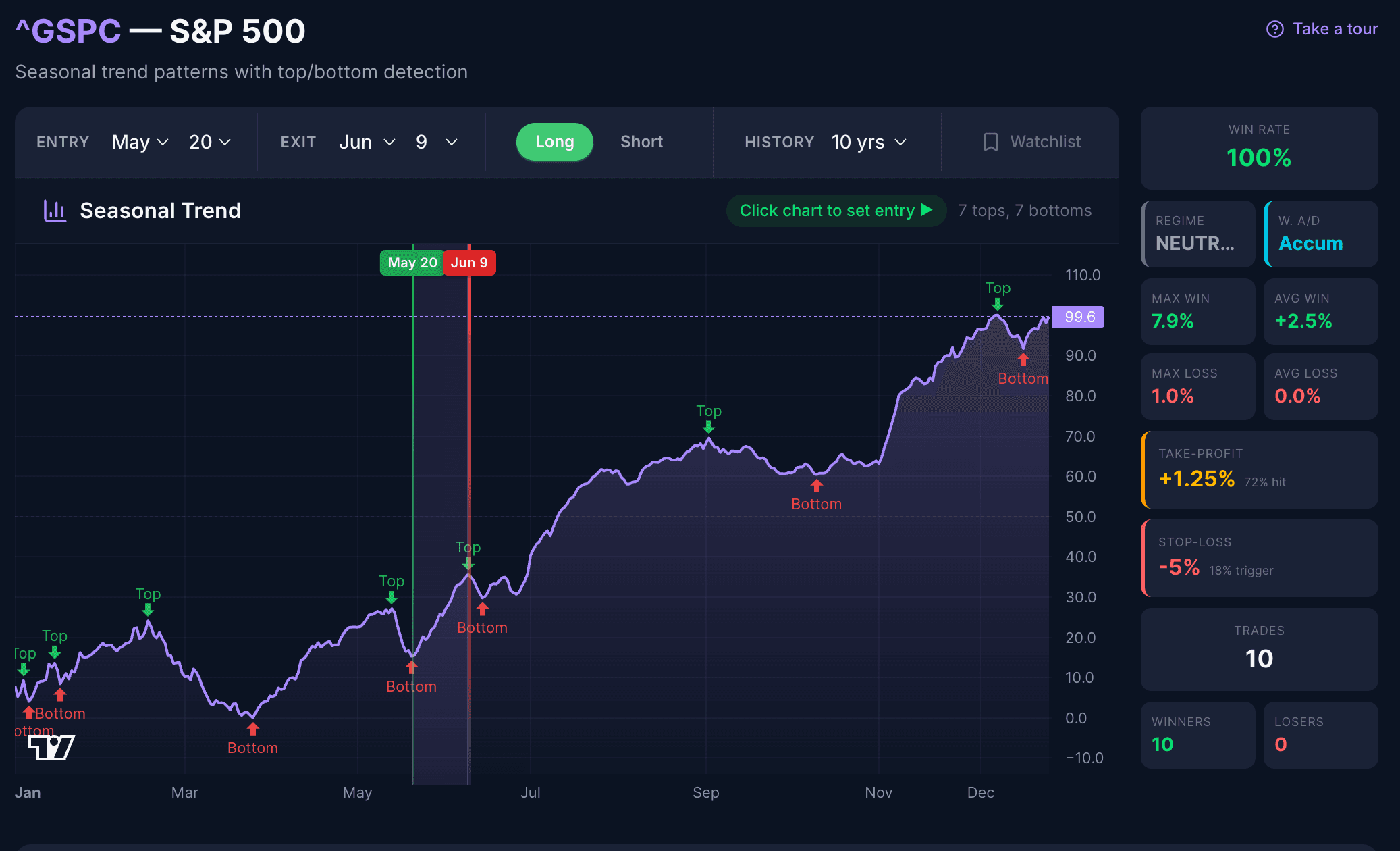
For the last 10 years, buying the S&P 500 on May 20 and selling on June 9 has won 10 out of 10 times, with an average return of +2.5%. The old “sell in May and go away” saying is broken in modern markets. But the equity curve cycle that has guided this pattern since 1950 is now rolling over.
The Saying That Stopped Working
“Sell in May and go away” is one of the most quoted seasonal adages in markets. The folklore version says investors should exit equities at the start of May and stay out until November, on the theory that the May-through-October stretch historically underperforms. For the broad May-to-October window, there is still a measurable seasonal drag — it is just much smaller than the saying implies.
But inside that six-month window are pockets of strong upside. The most consistent one in recent years is the late-May-to-early-June stretch on the S&P 500. Specifically, the 20-day window from May 20 to June 9 has been a long trader's dream: 10 winning trades out of 10 over the last decade, with an average return of +2.5% and a max drawdown of just 1.0% on the worst trade.
If you had sold in May the way the adage suggests, you would have missed every one of those gains. Across the full lookback to 1950, the pattern has run 76 trades with a 56.6% win rate and compounded $1,000 into $1,324. The recent decade is the strongest stretch inside that history.
The Trade: Long May 20 → June 9
The mechanical version of the pattern is straightforward. Each year, buy SPX at the close on or near May 20 and exit at the close on or near June 9. No filters, no stops, no discretion. Here is what that produced from 2016 through 2025.
| Year | Entry | Exit | Return | Result |
|---|---|---|---|---|
| 2026 | 2026-05-20 | 2026-06-09 | — | Upcoming |
| 2025 | 2025-05-20 | 2025-06-09 | +1.10% | Win |
| 2024 | 2024-05-20 | 2024-06-10 | +0.99% | Win |
| 2023 | 2023-05-22 | 2023-06-09 | +2.53% | Win |
| 2022 | 2022-05-20 | 2022-06-09 | +2.99% | Win |
| 2021 | 2021-05-20 | 2021-06-09 | +1.45% | Win |
| 2020 | 2020-05-20 | 2020-06-09 | +7.93% | Win |
| 2019 | 2019-05-20 | 2019-06-10 | +1.64% | Win |
| 2018 | 2018-05-21 | 2018-06-11 | +1.79% | Win |
| 2017 | 2017-05-22 | 2017-06-09 | +1.58% | Win |
| 2016 | 2016-05-20 | 2016-06-09 | +3.08% | Win |
100%
Win Rate (10/10)
+2.5%
Avg Win
+7.9%
Max Win (2020)
-1.0%
Worst Drawdown
Every year of the past decade has been a winner. The smallest gain was +0.99% in 2024; the largest was +7.93% in 2020, when the trade captured the back end of the COVID rebound. The worst intraday drawdown across all ten trades was just 1.0% — meaning the pattern has not only been profitable, it has been calm.
The Catch: The Equity Curve Cycle Is Turning Down
Here is where most seasonal analysis stops — with a long string of wins and a recommendation to take the trade. The problem is that even strong patterns have a rhythm. They run hot for a while, then cold, then hot again. The recent decade has been the hot half of that rhythm. The question worth asking is: what does the longer pattern say about right now?
We can answer that by compounding the full history of the pattern into an equity curve and running spectral analysis on the result. The compounded curve from 1950 through 2025 contains 76 trades and reaches $1,324 from a $1,000 start — a 32.5% total return with a 56.6% win rate. Crucially, that curve does not climb in a straight line. It alternates between hot streaks (long runs of green) and cold streaks (clusters of losses), with a dominant cycle period of roughly 16 trades.
The Bartels test — a statistical check for genuine cyclicality — sits at p = 0.314 in the latest reading, which does not clear the conventional significance threshold. That is itself informative: after a decade of unbroken wins that pushed the equity curve well above its long-term mean, the rhythm of hot and cold phases has become less periodic and more skewed. The visual character of the curve still shows clear cold-phase clusters — what has changed is that the recent run is so far above prior norms that it dilutes the cycle's statistical signature.
Current regime forecast: COLD
Cycle regime forecast over the next 3 trades: 33% HOT, 67% COLD. The regime classification has now flipped from NEUTRAL outright to COLD — the first cold reading the model has assigned this pattern in years. The curve is not predicting a loss — it is saying the structural tailwind that drove ten consecutive wins is no longer there.
This is the same insight that drove our earlier piece on equity curve regime filtering: a high win rate tells you the pattern works on average, but cycle phase tells you whether it is working now. Mature traders use both.
What Has Happened When the Cycle Was Going Down
If recent results were all the data we had, there would be no reason to worry. The discomfort comes from looking at the full 75-year record. The pattern's lifetime win rate is 56.6%, not 100%. That number is the average across both halves of the cycle — and the gap between the recent decade (100%) and the lifetime average has to be filled in somewhere. It is filled in by the cold phases.
Pulling the recent 10 wins out of the dataset leaves roughly 66 trades from 1950 through 2015. Those trades produced approximately 33 wins and 33 losses — almost exactly a 50% win rate. In other words, before 2016 the pattern was a coin flip. The recent decade is the outlier, not the rule.
56.6%
Lifetime Win Rate (76 trades)
~50%
Pre-2016 Win Rate (66 trades)
-17.1%
Lifetime Max Drawdown
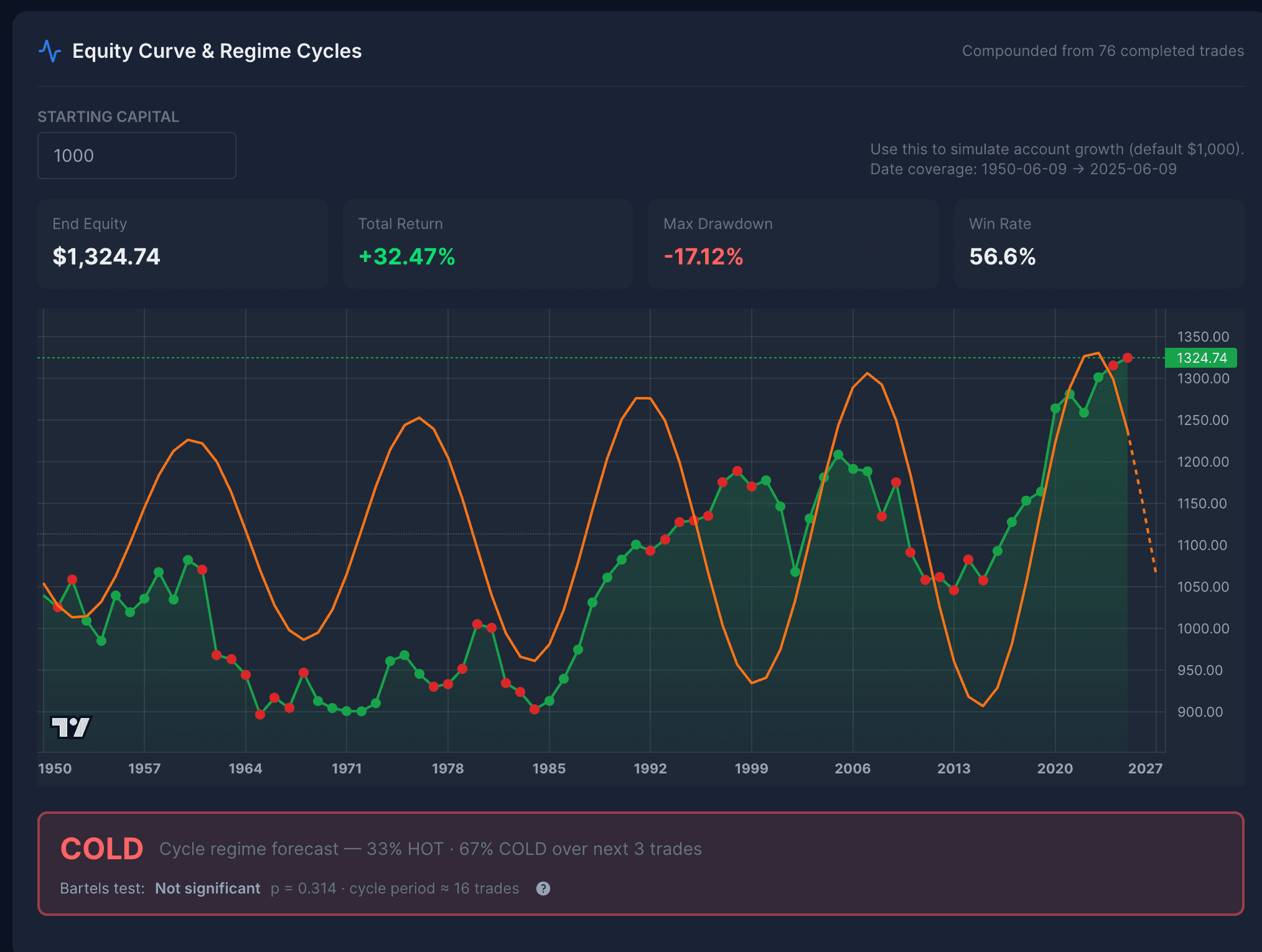
Three cold phases visible on the equity curve
The compounded curve from 1950 to 2025 makes the cold phases easy to spot. They are the long flat stretches and the multi-trade drawdowns where the orange cycle line is below the equity dots. Three of them stand out.
1950s – mid-1980s: structural cold phase
For roughly three decades the equity curve barely moved. Wins and losses traded blow-for-blow, the curve oscillated in a narrow band near its starting capital, and the pattern produced no compounded edge. This is the period that drives most of the lifetime 43% loss rate. Anyone trading the pattern mechanically in this window would have ended where they started.
Early-to-mid 1990s: the first sharp drawdown
The curve made a local peak in the early 1990s and then gave back several trades worth of gains over the next 4–5 years. Multiple consecutive losing trades clustered in this window. The cycle model marks this as a clear cold phase — the curve drops below the long-term mean before resuming.
2007 – 2015: an eight-year sideways grind
After the 2006–2007 peak, the equity curve traded sideways for nearly a decade. Individual trades were often green, but the wins were small and were repeatedly given back by losing years. The 2007 high was not meaningfully exceeded until 2018. A trader who entered the pattern in 2008 spent ten years effectively flat.
The shape of a cold-phase trade
Cold-phase losses are usually not dramatic. Looking through the 35 historical losing trades, the average losing trade comes in around –2% to –3%, with a handful of worse outliers reaching –5% to –7%. The pattern does not blow up — it simply stops working. Hot-phase wins of +2% to +8% get replaced by chop: a small win, a small loss, another small loss, a marginal win.
The lifetime maximum drawdown of −17.1% on the compounded curve was not produced by a single catastrophic year. It accumulated trade by trade, mostly during the 1950s–1970s structural cold phase. That is the characteristic signature of this pattern's cold side: quiet, repeated underperformance rather than a single bad event. The risk during a cold phase is not a crash — it is the slow grind of small losses that prevent compounding for years.
What the Filters Say
We ran two independent filters on the recent 10-trade window to see whether either would have skipped any of the wins. The first is the Williams Accumulation/Distribution indicator: only take longs when WAD is above its 57-period moving average. The second is the equity curve HOT regime filter: only take longs when the cycle phase is hot.
All Trades
Williams A/D Filter
EC HOT Filter
The Williams A/D filter passed 9 of the 10 trades and kept the 100% win rate. It did not flag this pattern as risky during the run. The HOT regime filter, in contrast, was far more selective — it only took 3 of the 10 trades. Those three still won, but a run filtered by the HOT signal captured far less of the decade's gains.
The two filters reveal different things. In a hot phase the unfiltered pattern tends to run cleanly, so even loose confirmation tracks the outcome. In a cooling phase, the HOT regime filter becomes more discriminating — precisely because the unfiltered pattern is statistically more likely to break. The current cycle reading is moving toward the second kind of environment.
The 2026 Setup: What the Data Is Showing
The next instance of this pattern runs from May 20, 2026 to June 9, 2026. Compared with the last ten years, the 2026 setup is unusual: every standard read on the pattern itself is strong, but every long-horizon read on the cycle is weakening at the same time.
What is unchanged in 2026
The base rate of 10 wins in 10 attempts is still on the record. The structural drivers cited for the late-May rally — Memorial Day inflows, end-of-quarter positioning, the lead-in to the summer rally — have not changed. The Williams Accumulation/Distribution indicator is currently above its 57-period moving average, which is the same confirmation read that was present during every winning trade in the last decade.
What is different in 2026
The cycle phase has rolled over. After ten consecutive wins pushed the compounded equity curve well above its long-term mean, the dominant 16-trade cycle is now turning down. The regime model has shifted from a sustained HOT read to a COLD classification, and the forward forecast for the next three trades is 33% HOT / 67% COLD — the first cold reading the model has assigned to this pattern in years.
What history says about that combination
Across the full 1950–2025 record, the trades that produced this pattern's losses tend to cluster in the cold half of the cycle, not the hot half. The hot phase contains nearly all of the +2% to +8% winners; the cold phase is where the 22 historical losing trades concentrate. The pattern itself has a 56.6% lifetime win rate — the recent 100% run is the upper end of its distribution, not the middle.
The point of running both reads — recent base rate and long-term cycle — is that they can disagree, and that disagreement is itself information. “Sell in May” would have looked wrong for ten straight years. The cycle framework says the next ten may not look the same.
Frequently Asked Questions
Is “sell in May and go away” still true?
Not for the last 10 years. The S&P 500 has been a buy, not a sell, in late May. Specifically, going long on May 20 and exiting June 9 has produced 10 winning trades out of 10 from 2016 to 2025, with an average return of +2.5%. The broader May-to-October period still shows mild seasonal weakness on average, but the saying overstates it.
What is the late-May seasonal pattern in the S&P 500?
Buying the S&P 500 around May 20 and selling around June 9 has been one of the most reliable short-term seasonal patterns of the past decade. Across 2016–2025 the window produced 10 winners out of 10, with the best year (2020) returning +7.93% and the smallest winner (2024) returning +0.99%.
What is an equity curve cycle regime?
The equity curve cycle regime is the rhythm of a seasonal pattern's wins and losses over time. Spectral analysis of the long-term compounded curve reveals the dominant cycle, and the current phase determines whether the pattern is in a hot phase, a cold phase, or transitioning. For the May 20 → June 9 long, the cycle period is roughly 16 trades; in the latest reading the Bartels test of statistical significance has slipped to p = 0.314 as the recent run has skewed the pattern away from a clean periodicity.
Why is the cycle turning down if the win rate is 100%?
Recent win rate and cycle phase are two different signals. The win rate measures whether the last 10 trades worked; the cycle measures where you are in the longer rhythm. Ten straight wins pushed the equity curve well above its long-term mean, which is exactly what bends the sine wave back toward a peak. The regime forecast over the next three trades is now 33% HOT / 67% COLD — and the regime classification has flipped from NEUTRAL to COLD outright.
How does the 2026 setup compare to recent years?
The pattern itself looks the same: same calendar window (May 20 – June 9), same structural drivers, same Williams A/D confirmation. The difference is the cycle reading. For each of the last ten trades the equity curve regime was HOT; the 2026 read is COLD with a 67% cold probability over the next three trades. Historically, the losing trades in this pattern cluster in the cold half of the cycle. This article is research and analysis, not investment advice — it does not recommend any action.
Disclaimer. This article is published for research and educational purposes only. It is not investment advice, not a recommendation to buy, sell, or hold any security, and not a solicitation of any kind. Historical seasonal patterns and backtested results do not guarantee future returns. The 2026 instance of this pattern has not yet occurred and its outcome is unknown. Anyone making a financial decision should do their own research and, where appropriate, consult a licensed professional.
See the Cycle Live on Your Watchlist
Seasonal Edge runs the equity curve cycle model on every seasonal pattern across 4,500+ symbols. Explore the regime forecast, the Bartels test, and the HOT/COLD phase for any symbol on your watchlist.
Free preview includes AAPL, NVDA, and TSLA. 50% off for early adopters. Cancel anytime.